
So many of life’s most pivotal decisions come down to one question: Should you listen to your logic or your emotions? Popular culture often frames this tension as a struggle between two minds — a “more evolved” rational layer built atop an ancient “lizard brain” driven by primal instincts.
This battle of the brains has also been playing out over the course of evolution, but not as a simple clash between old and new.
“There was a theory proposed in the ‘50s that the brain evolved in layers starting with basic bodily functions, to emotions in the reptilian brain, leading up to sophisticated reasoning in humans,” explains Nabil Imam, an assistant professor in the School of Computational Science and Engineering and a faculty member with Georgia Tech’s Institute for Neuroscience, Neurotechnology, and Society (INNS). “This is not how an evolutionary biologist would think about the problem.”
Instead of a “new” brain layered over an “ancient” one — or even a logical brain versus an emotional one — research published in Science Advances reveals that brain evolution may come down to wiring.
By studying the architecture of both biological and artificial brains, Imam’s team found that brain evolution is a strategic allocation of limited real estate. They propose a computational tug-of-war between two fundamentally different types of internal wiring — ones established even before birth.
This new understanding not only helps resolve a longstanding mystery in brain evolution but could also help us design more efficient AI systems.
The Problem With the “Lizard Brain”
When we refer to our “logical” or “lizard” brains, we’re really talking about different groups of brain regions. The logical brain is known as the neocortex, the brain’s outer layer responsible for vision, perception, reasoning, and other higher-level functions. For the lizard brain, the story gets a bit complicated.
“The limbic system, sometimes called the ‘reptilian brain,’ controls emotion broadly speaking — but it also has other components with distinct functions,” explains Imam. The system has separate regions for memory, smell, and navigation in addition to emotional regulation. “Why do people group all these different regions into one big system? There hasn’t been a good theory for what is common between these different circuits.”
To investigate, Imam’s team looked beyond individual regions to examine how these systems scale across species. Instead of comparing single areas based on function, the team analyzed how the limbic system and the neocortex change together across evolutionary history.
The result was remarkably consistent. When one component of the limbic system was larger, the others were also larger, while the neocortex was consistently smaller. These regions don’t vary independently. “Rather,” says Imam, “it’s a coordinated expansion of these regions across species.”
This reveals something new: The limbic system behaves not as a loose collection of functions, but as a unified network that expands and contracts as a group across evolution.
But what is driving this coordinated push and pull?
Maps Versus Barcodes
Imam argues that it comes down to how these different parts of the brain are wired before birth.
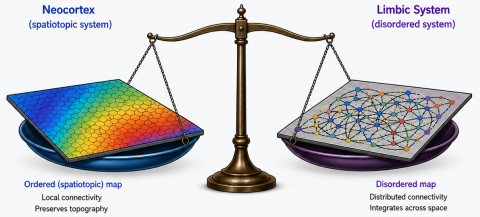
In the neocortex, neural circuits are organized as spatial maps. Areas that process touch in nearby parts of your body, like your index finger and thumb, are physically close to each other in the brain. The same is true for sight and sound.
Wires in the limbic system, however, are not spatially organized. They function more like a bar code, firing in unique, distributed patterns to represent specific scents or complex memories.
To test whether this was an innate trait or acquired through experience, the team developed AI models for different senses. They found that when they pre-wired an AI with localized, spatial connectivity, the network was naturally very good at processing vision, sound, and touch information. Conversely, distributed, “barcode-style” networks were essential for the AI to excel at scent recognition and memory.
The Evolutionary Tug-of-War
The final piece of the puzzle explains how the size of brain components changes predictably across species. Because resources like space and energy are limited, natural selection chooses which system to prioritize.
The team simulated evolution by creating a multimodal network where the spatial and distributed domains competed for “real estate.” When the environment rewarded smell, all areas of the distributed system expanded and the neocortex shrank. When vision was rewarded, the opposite occurred.
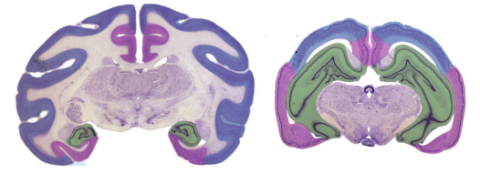
This explains why the nine-banded armadillo, which relies on scent, has a massive limbic system, while the highly visual squirrel monkey is dominated by its neocortex. Across the 182 species studied, the research shows that brain evolution is not about adding new layers of "logic," but about strategically reallocating space between different wiring systems to support survival.
By translating this biological architecture to AI systems, engineers could create machines that learn as efficiently as the human brain, requiring far less data and energy.
“Today's artificial neural networks are trained by vast amounts data — it’s about nurture,” says Imam. “But the brain is not a blank slate that gets trained by experience. It is a mix of nature and nurture, and the nature is that pre-wired architecture.”
“We could translate that architecture to AI systems to make it more brain-like, or make it learn or function as efficiently as the brain.”
This work was a collaboration with Cornell University and was supported by the National Science Foundation.
Writer
Audra Davidson
Institute for Neuroscience, Neurotechnology, and Society
Media Contact
Bryant Wine
College of Computing