
Misjudge a curb or miss a step on the stairs, and there is a split second of panic as your foot doesn’t land when you expect it to. That brief loss of pressure can be enough to throw off your balance entirely.
For most, that heart-pounding uncertainty ends the moment the foot finds solid ground. But for many individuals living with conditions like stroke or spinal cord injury (SCI), that sense of disconnect is a permanent reality.
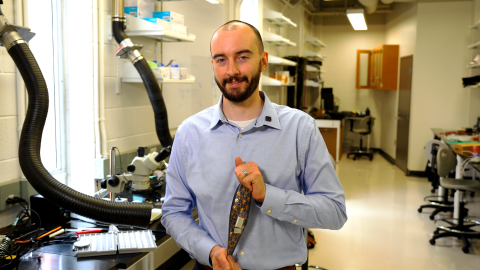
“These conditions of course have a huge effect on our ability to move around and be independent — but the other side of it is the sensory feedback that we lose,” says Matthew Flavin, an assistant professor in the School of Electrical and Computer Engineering. Most rehabilitation treatments primarily focus on restoring movement, but “even if you have motor control, if you can’t feel when your foot's touching the ground it can be really hard for you to move around safely.”
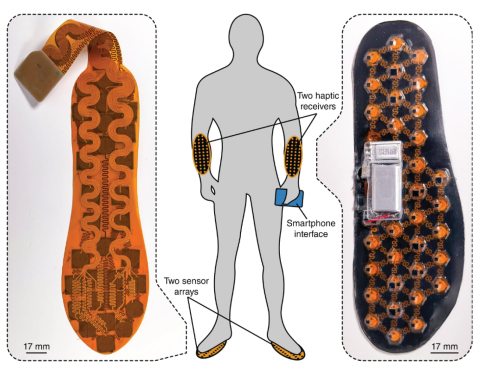
In a new study published in Proceedings of the National Academy of Sciences, Flavin and an interdisciplinary team of researchers introduce a way to bridge this gap: a wearable “sensory substitution” system that translates foot pressure into high-tech patterns of heat and vibration they can feel elsewhere.
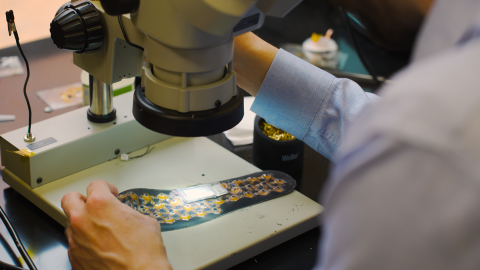
The system uses high-resolution pressure-sensing insoles designed by the team, which are placed inside a user's shoes to record how their weight shifts in real-time. This data is streamed via Bluetooth to a flexible, skin-conformable array of haptic receivers worn on the forearms, a part of the body that often retains sensation in SCI. The receivers give quick pressure feedback through vibration, while also alerting the user to longer-term pressure “hotspots” through heat.
“One of the limitations of a lot of approaches in haptics is that you're having to map a missing sense onto a completely different sense,” says Flavin. “We’re keeping the type of information that we're missing, which is the distribution of pressure, and we're just basically putting it on a different part of their body.”
Rerouting the lost sensation was key to making the device intuitive to learn. Participants were able to correctly identify the “feel” of the ground through their arms with high accuracy within a mere two-hour session. When tested with a small group of participants with stroke or SCI, the wearable significantly improved standing balance and led to steadier walking.
“What’s encouraging about these early results is that participants appeared to use the feedback in ways that supported balance and walking,” says John Rogers, a materials science and engineering professor at Northwestern University who collaborated on this study. “Our study suggests that providing pressure information through another part of the body could be a practical path for helping people compensate for lost sensation.”
While vibration provides immediate feedback for walking and balance, the team views the thermal feedback as a tool for long-term health. Heat is a slower, low-frequency signal that could alert patients to pressure hotspots, potentially preventing diabetic foot ulcers or pressure injuries for those who are bedridden or use wheelchairs.
The small, lightweight system is completely untethered, making it suitable for use during daily activities in and outside the clinic. It’s also highly adaptable to different injury types, which is ideal for conditions as variable as stroke, SCI, and diabetic neuropathy. Placement of the haptic receivers can be adjusted based on where a patient has the most sensation, and the sensitivity of the insoles can be tailored to each patient.
As a member of several of Georgia Tech’s Interdisciplinary Research Institutes — the Institute for Neuroscience, Neurotechnology, and Society, the Institute for Robotics and Intelligent Machines, and the Parker H. Petit Institute for Bioengineering and Biosciences — Flavin credits the project’s success to an interdisciplinary effort and deep engagement with clinicians and patients.
“This reinforces the importance of really engaging with your stakeholders very early on,” says Flavin. “If you're not continually refining that concept with those stakeholders, you quickly find that they might be looking for something that your device isn't delivering.”
With new funding from the National Science Foundation (NSF), the team is now working to make the technology even smaller and more reconfigurable, moving closer to a standard wearable for daily clinical use.
Writer and Media Contact:
Audra Davidson
Research Communications Program Manager
Institute for Neuroscience, Neurotechnology, and Society (INNS)
Photos:
Maxwell Guberman